

PDF · instant download · no subscription
What you call from the bench, and what your team does when you call nothing
90 plays, each one with what it is for, the personnel it needs and how it gets stopped. Plus the spacing rules for the twelve seconds left after the play breaks down. Most teams play well with six or eight actions, not sixty: this is a playbook to choose from, not one to copy whole.
Free with any purchase
A practice plan built for your level, not a generic one
Tell us the age group, the level you coach at and how many practices a week you get. We send back a practice plan built around it: which of these actions to install first, in what order, how many minutes each block takes and what to look at three games later to know whether it stuck.
It is not a report on your team — we do not have your game data. It is the installation plan, and it is the part most playbooks leave out.
Or take the lot
Everything: the playbook, the defensive manual and all ten booklets
The complete playbook, the defensive manual and the ten family booklets as separate files, so you can print one family per assistant without handing over the whole book.
- Tactical playbook · 90 plays
- Defensive manual · 37 rules
- The ten family booklets, as separate files
Or just the family you need
The ten notebooks are the playbook split by family. Together they hold exactly the same 90 plays and 270 diagrams, with the same one-page sheet per play.
What it looks like inside
Real pages, untouched. Zoom in if you want to read the diagrams.
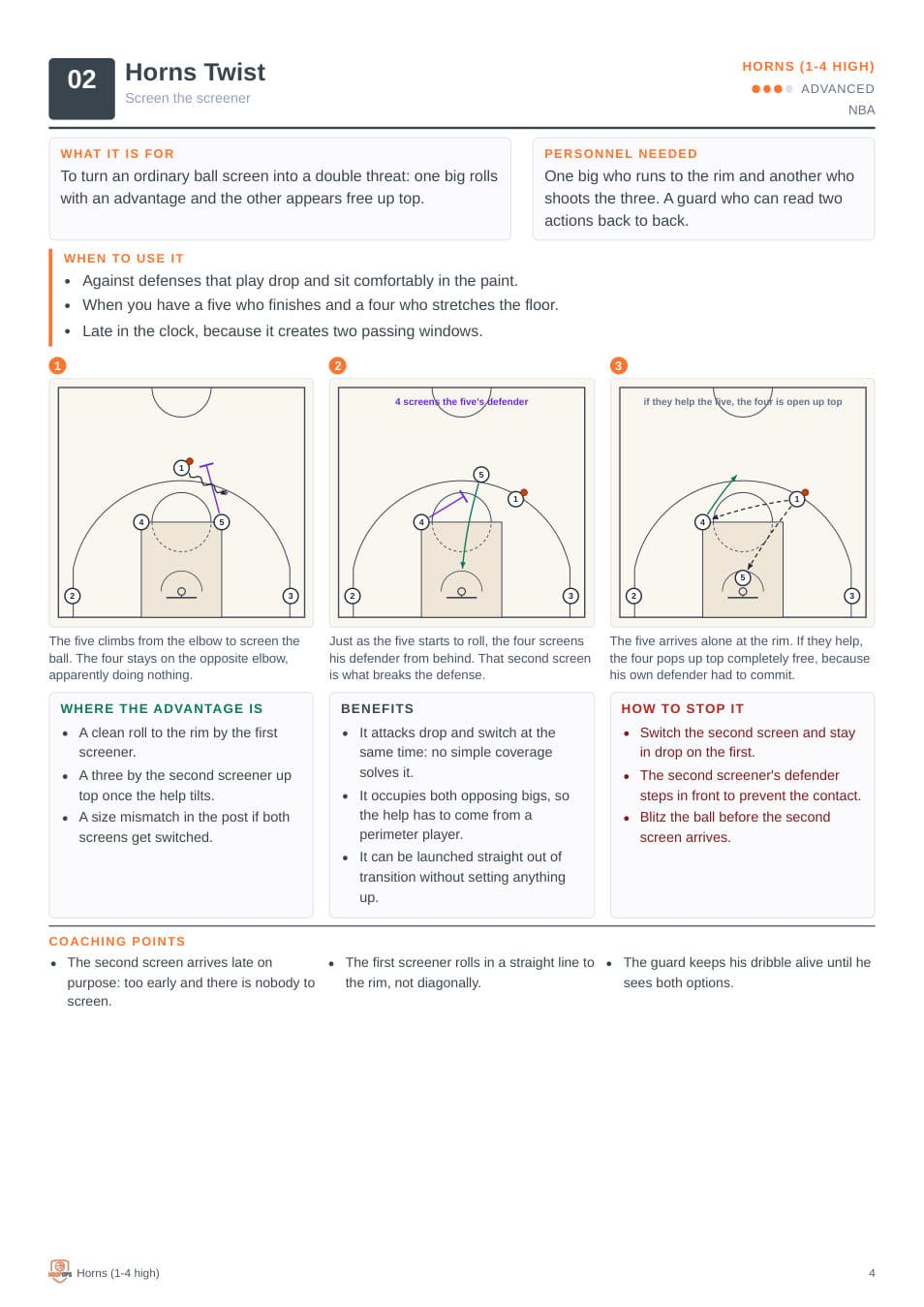
One play, one page
What it is for, the personnel it needs, when to use it, the steps in diagrams, where the advantage is, the benefits, how to stop it and the coaching points.
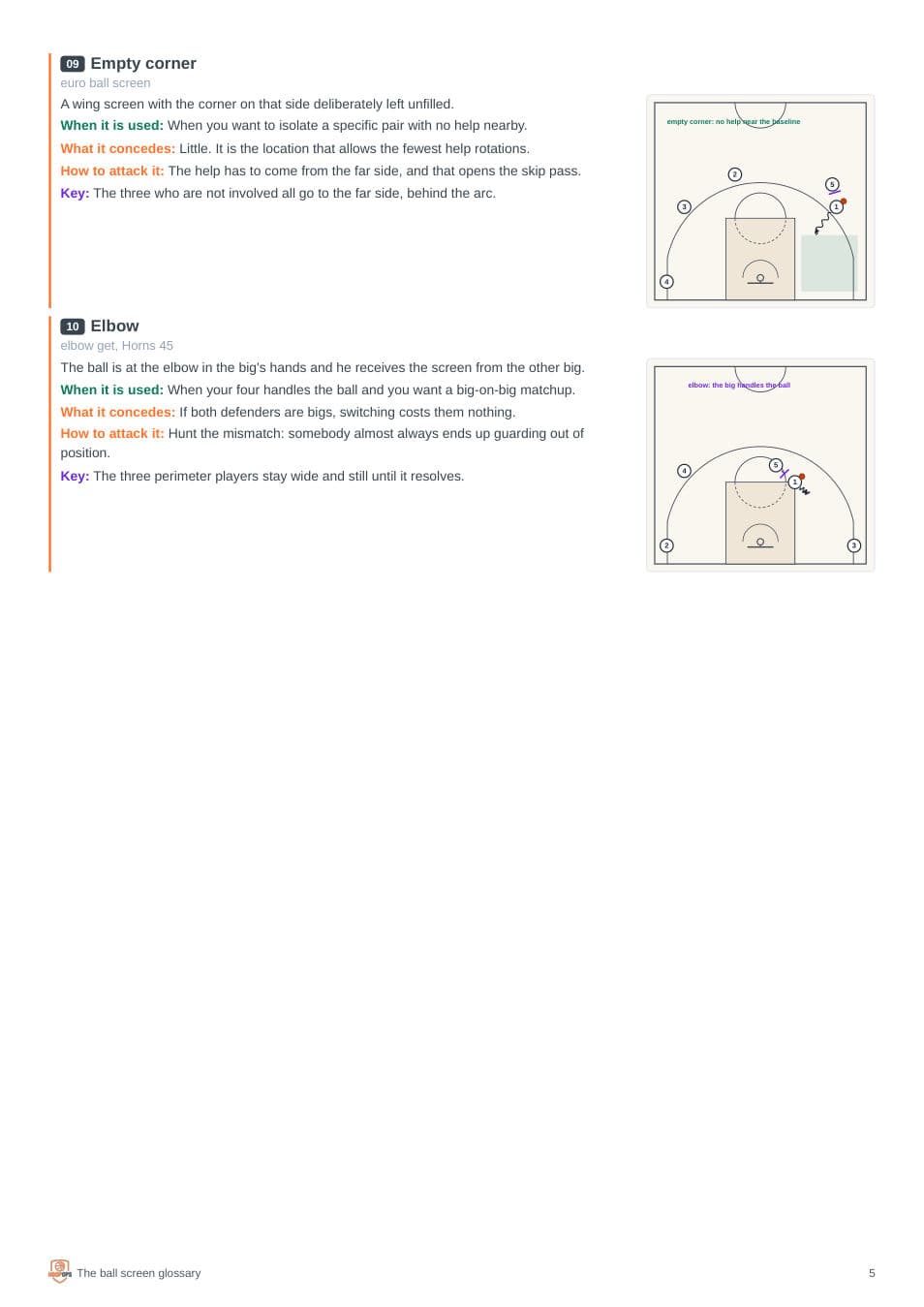
One term, one diagram
Every glossary entry gives you the name, what it is, when it is used, what it concedes and how it is attacked.
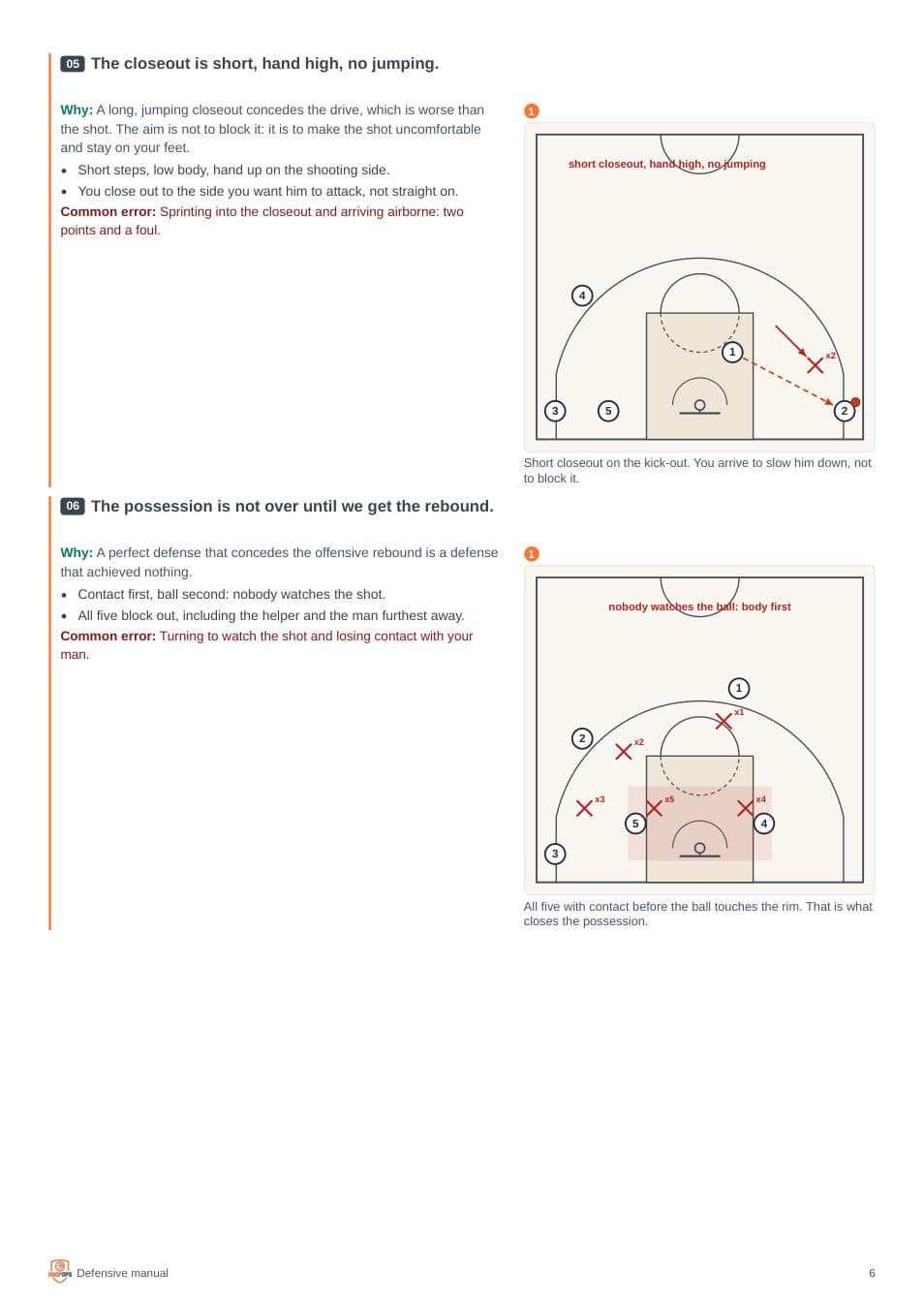
One defensive rule, one diagram
The defensive manual works the same way: every rule with why it exists and what it concedes on purpose.

The booklet index
Every booklet opens with its plays, their difficulty and where each one comes from.
What you get
- Every play on its own page, with the sequence drawn step by step.
- What it is for, the personnel it needs, when to call it and where the advantage shows up.
- How it gets stopped — which tells you how to guard it when it is run at you, and what the other bench is looking for when you run it.
- A difficulty level and the origin of every action.
What it is not
- Not a closed system you have to adopt whole.
- Not video. These are court diagrams: you read them on the couch and print them for your staff.
- Not analytics. If what you want is your own numbers, that is the app.
Questions
What exactly do I get, and when?
A PDF, in your inbox, as soon as the payment clears. No subscription, no access that expires, no account to create. The file is yours to print and hand to your staff.
Is this written for American basketball?
The plays come from European and American basketball, and the terms are the ones your staff already uses — pick and roll, horns, flare, ICE, drop, blitz. Court diagrams are drawn to FIBA dimensions, which differ from NCAA and NFHS in the lane and the three-point line, but the spacing principles hold on any floor.
Can I use these with a youth or high school team?
Every play carries a difficulty level (basic, intermediate, advanced, elite) and states the personnel it needs. Basic plays install in one session and require no reads. The elite ones need players you probably do not have, and the document says so.
Do I get updates?
Yes, and they cost nothing. If we improve a document, the new version appears in your order page automatically. You are not asked to pay again.